March 25, 2026
I want to tell you a story about a beach.
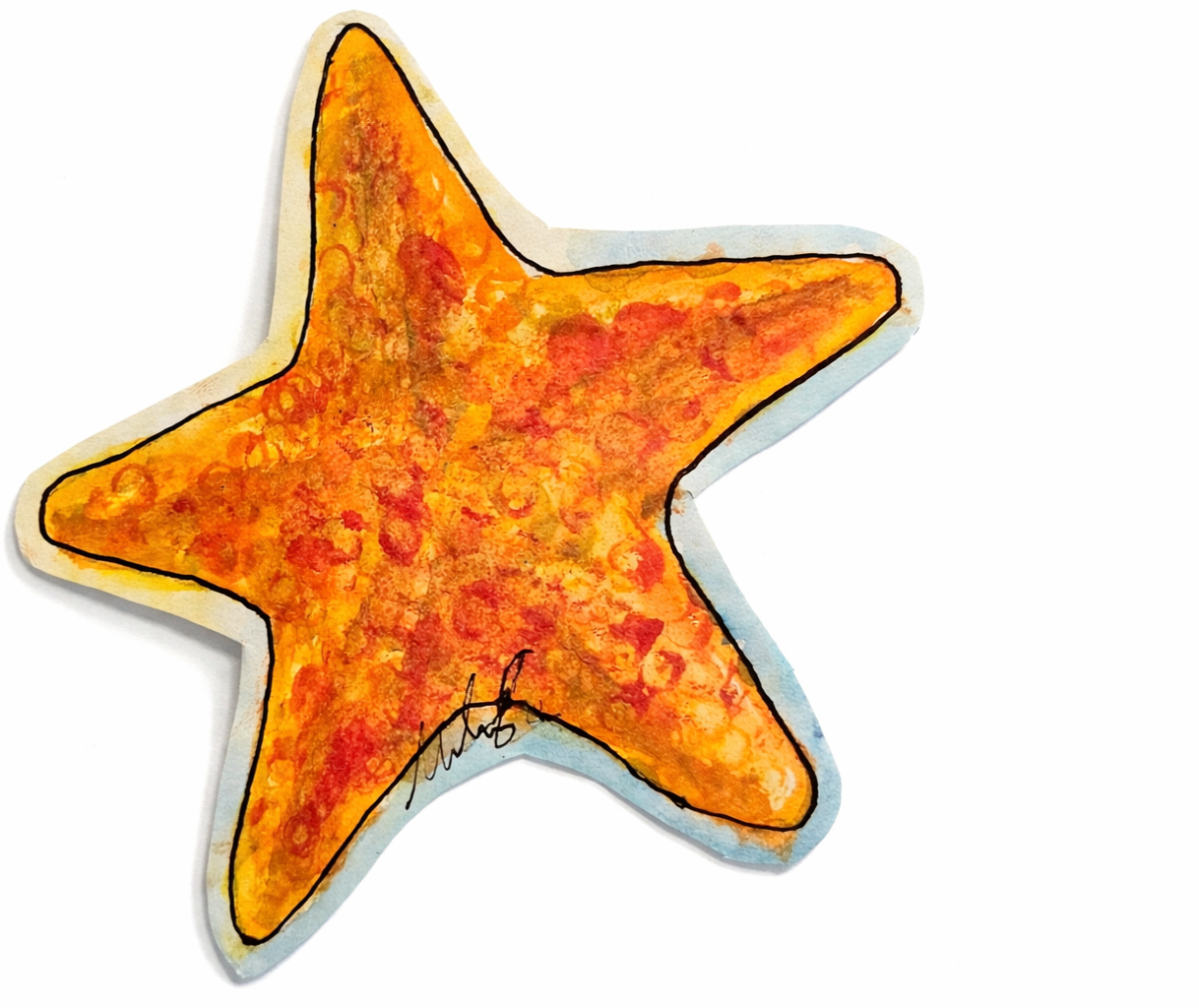
A violent storm had passed, and the sand was covered in starfish; thousands of them, drying in the sun. Not dead yet. But not in the water either. Suspended between survival and disappearance.
A man watched a little girl pick them up, one by one, and throw them back into the ocean. He laughed at her. He told her she was wasting her time. She couldn’t save them all.
She looked at the starfish on the sand, bent down, picked another one up, and tossed it into the waves.
“It mattered to that one.”

Many times in my life, I have been girl. And a great many other times, I was the starfish.
And for a long time, I was neither fully awake nor fully free.
On March 28, 2026 I will be celebrating five years from alcohol, and 11 years from my DOC. However, even through years of “raw-dogging” my sobriety, I hadn’t yet learned what it meant to live and think SOBER. I didn’t understand what recovery meant.
No matter how well I adapted, I still felt stranded—high-functioning, accomplished, admired, and profoundly disconnected from myself. Most of my addictions happened in solitude. Most of my survival happened in silence. I was technically sober and at times even clean, but I wasn’t recovering. I was surviving. I wasn’t falling apart on the outside, I was eroding quietly on the inside. I was consistently choosing to NOT choose me.
In humbling honesty, those biggest shifts came within the last year. My real recovery started when I realized the life I so desperately craved stopped being a secular something I fought for and became something I lived.
I also discovered that addiction doesn’t differentiate. And on a deeper level, my addictions were always about what was hurting, what I was avoiding, or what I was chasing. And I knew it too. And I ignored it.
Through my recovery I’ve begun to understand that my addiction grew out of fragmentation of self and a lifelong need for control. My drug of choice was never just a singular substance, it was a concoction of anything that could give me power over my body and my feelings. Cutting. Restricting. Purging. Alcohol. Uppers and downers stacked on top of each other and washed down with whiskey or wine until the world quieted enough for me to breathe.
Throughout my addiction, trauma continued to strip me of choice again and again, and control became the only language my body knew.
Many of the wounds I had been avoiding began long before I had language for them. And without the understanding of these challenges, I learned to function in ways that kept me alive but also avoidant. Looking back on just a few of these moments that shaped my journey of what healing looked like for me.
Adopted at birth, something I rarely thought of as trauma, was the first of those wounds. Adoption was framed as a blessing, a story of divine intervention and belonging. And almost every way it was. But the body remembers things long before the mind understands them and somewhere beneath unconscious threads of memory, my nervous system learned something simple but devastatingly brutal: that connection can disappear instantaneously and you did nothing wrong. Later on in life, adoption taught me through social experiences outside of my family, you don’t belong.
I grew up in a religious home where family was sacred and marriage was eternal. Families were sealed together for time and all eternity. From the outside it looked stable, structured, even ideal in some ways. But even as a child I sensed something that no one said out loud. At the time, my parents stayed together, but they were not happy together. The tension lived quietly in the spaces between them, in conversations that ended before honesty could fully arrive. What I absorbed from that environment was also simple, but lasting. Love meant staying. Love meant enduring. Love meant commitment even when something inside you was backing down. Love didn’t last.
School gave me another identity entirely. I was the strange kid, the one who never quite understood the dance of belonging the way everyone else seemed to. Children notice difference with an almost surgical precision, and they noticed mine early. Not just one single event but a childhoods worth ingrained that it was necessary to dial it down to find acceptance. Make yourself tolerable.
Eventually I stopped trying to sit in the center of the room because it was exhausting and cruel and instead found my place at the edges. And something interesting happens at the edges of a room. I began to notice the other people standing there too. The quiet ones. The lonely ones. The kids who already knew they did not belong in the middle either. Instead of trying to become the girl everyone liked, I became the girl the lonely kids could sit next to. I defended them when they were bullied. I listened when they needed someone to hear them out. I invited them to play so they didn’t spend recess alone by the fence. Without realizing it, I became a quiet caretaker for the small herd. Even then, I had a strange instinct to stand between people and harm.
I did not realize then how often I would end up standing there alone.
And another quiet truth was learned, I could belong anywhere, as long as I did what I could do to make others feel seen. And I learned I liked being the person that helped others feel safe, even if I didn’t.
When I was fifteen something inside my world fractured in a way I did not know how to explain. I began having spiritual experiences that felt intensely real to me. Moments that felt like warmth, connection, a sense of belonging to something larger than myself. And for a brief time it felt as though I had discovered a language the rest of the world had forgotten. I also walked a fine line between embracing our gifts and psychosis. I was told that kind of intuition was dangerous, unstable, something that could easily be mistaken for delusion. That I would end up in a mental hospital if I wasn’t careful who I talked to or what I said. I abandoned my higher power and learned that true beliefs that had given me a solid foundation were impermanent, unstable, and hocus pocus. That connection to any higher power, even intuition, was dangerous.
That same year addiction quietly entered my life. Alcohol, intentional self-harm, an undiagnosed eating disorder, and over-the-counter medications taken in ways they were never meant to be taken, and naturally progressed from there. None of it looked dramatic from the outside, it looked like a teenager trying to navigate intense emotions who firmly believed that those emotions had nowhere safe to land. I had learned how to become a chameleon and had started building the basis for my survival tactic.
It was then that Control became my first addiction. If my emotions became too loud, I could numb them. If my body felt like something the world could take from me, I could take control of it first. It didn’t feel like survival and it definitely didn’t feel like destruction. It felt like relief. I found that relief comes at a price, but at that time, the release was worth the cost.
Those patterns followed me into adulthood. By the time I reached my twenties, control alone was no longer enough. My drug of choice became something more complicated—a pristinely and precisely layered concoction of uppers, downers, and alcohol. A calculated practice that could create enough distance between myself and the feelings I did not know how to survive, and doing so without accidently ending my life. I still had to maintain the appearance that I was in control.
When the precise and measured control of my DOC no longer became enough, I began intentionally dancing with Death. It grew to a point where I deliberately did not want anyone stopping me with how, when, or how much I took, so I continued to do what I did in secret. I went to a party, and another party, then a club, and somewhere in the middle of the night my body began shutting down. My vision collapsed into darkness. My muscles stopped responding the way they should. Somehow, I stumbled outside and just before I remember thinking I should have hit pavement, someone caught me.
The next morning, one thought pervaded my annoyance that I woke up.
I should not be alive, but something kept me here because I had a purpose.
Part of me had believed the sand would finally take me. That I would dry out there quietly like one of thousands of forgotten starfish—a small, brittle relic of a life that once thrashed and breathed and tried.
But I was still here. And I did not yet understand why. And in that moment, a new understanding began to take shape, that I did have a purpose and some kind of higher powers were present. That there was a purpose for me that I was meant to fulfill.
That was not my last bout with my DOC, but it was where hope started.
Not long after that I entered my first marriage. From the outside it looked stable and faithful. Inside it slowly became something else entirely. What I believed was Love began to look like permission—permission to exist, permission to sleep in my own bed, permission to enter a room without triggering someone else’s anger. Peace and permission to exist became something I learned to earn by shrinking.
Years later, my life fractured again in ways that still feel difficult to describe. Amongst other traumatic occurrences during this time period, I had become pregnant. Early I to my second trimester, I was told that the baby’s heart had stopped but my body was refusing to recognize it as a miscarriage. Due to living in a small town, the surgical procedure wasn’t deemed as life threatening and was scheduled four weeks out.
There is a particular kind of silence that lives inside a body after that.
Three days after the procedure, the father of the unborn baby sexually assaulted me.
From the outside, I appeared composed, even vibrant. Because I looked functional, people close to me quietly questioned whether the assault had actually happened. That experience taught me that no one hears truth, and even if they did, solace was deflected out of discomfort.
Something inside me shut down after that and I entered back into one of my deepest throws with alcohol. What replaced it was survival and it was cold, efficient, and relentless. My emotions flattened, logic and risk replacing tenderness. I moved through the world like both a predator and a ghost—present, functioning, but disconnected from almost everything that I actually loved about myself.
Addiction and repeated behavior patterns continued to follow me through the years. I would dive back in, clean myself up, and continue functioning the way I thought I was meant to function. Yet, I was still harnessing core lessons that shaped my desperation, and I was fighting to keep my head above water.
Those patterns followed me, everywhere I went and everything I did. I found myself living out all my negative core beliefs in one singular complex situation. And I had been doing so for years. I had alleviated addiction, but the source of needing to escape remained.
Not long before a major shift in my healing took place, I also entered the longest manic episode I have ever consciously experienced. For more than five and a half months, my mind moved faster than I could contain. Ideas poured out of me faster than I could write them down. I created constantly. It was beautiful. And it was addicting.
And I was slowly unraveling.
Within that chaos, something unexpected happened. I realized that something needed to change. Or I would lose my chance at living a life I could possibly come to love. For the first time in my life, I began noticing myself. Not in the shallow language of self-care, but in a deeper way. The kind of awareness that arrives when you realize you are the only person responsible for not just keeping yourself alive, but truly responsible for what you believe you deserve.
Within this mania, a woman named Jen said something to me that I will never forget.
“I see you searching for someone,” she told me gently. “Whoever that is, I hope you find them.”
For a long time I believed she meant a partner. Slowly, I began to understand the truth hidden inside her words.
I wasn’t searching for someone else. I was searching for myself.
The terrifying part was realizing she had been there the entire time, waiting patiently while I kept abandoning her in order to survive.
Shortly after that realization, I found the CaliSober recovery community. What struck me first was the honesty and the accountability. Recovery there did not ask me only to stop using substances. It asked me to stop escaping my own life. It asked me to sit with the uncomfortable emotions I had spent years trying to outrun and to listen carefully to what those feelings were trying to teach me.
And then, slowly, something unexpected began happening. The compassion I had spent most of my life giving to other people began extending toward myself.
After that crucial change in my perception of self-love developed, someone came to say something that would shift the trajectory of my life. This person wasn’t part of my “tribe” until later, yet his words shifted my reality.
“What you’re going through is abuse.”
He did not know the full story. He didn’t even know the tip of the iceberg. But he stayed through the uncomfortable and that gave me the confidence to continue to subtly shifting the precedence for choosing myself.
“You have people who have your back.”
And for the first time in a long time, I felt safe in someone else’s words. And I still didn’t know why. And that was terrifying for me. Through the process of finding a community, I began unlearning most of the truths I had cemented into my soul. I was enough. I wasn’t too much. I was lovable. I was a spazz. I was goofy. I was quiet. I had choice. I was receiving love and acceptance because I had made the choices to be brave and vulnerable and encouraged myself to trust others, in entirety.
Then there was the night in my living room that I will never forget. It wasn’t an explosive moment – just telling and tension. But this time I wasnt standing down. I did not shrink and stood my ground. Until a brave little voice cut through the tension.
my son stepped between us, with little hands raised in protection. To protect me.
“Dad, stop!”
Lyrion.
Small body. Big voice.
My child was protecting me. And in that moment, I realized my son was learning his own lessons and how to carry a burden that had never been his.
These were MY truths that were beginning to imprint on my babies. My demons were starting to raise my children.
I looked at my boys and something inside my chest collapsed under the weight of the truth. They were learning what love looked like by watching me disappear. By tolerating survival, and I was teaching them that this is what the expectation for their own happiness was.
Something inside me had shifted in a way that could not be undone. Once you see something that clearly, you cannot return to the comfort of not knowing.
There’s a reason I told you those few highlighting moments.
Not for sympathy, not to be understood, or to create empathy for the story. I told them because my body learned things long before I had language for them, and those lessons did not stay in the past. They shaped the way I moved through every room, every relationship, and every version of myself I became in order to survive. And these were only a handful.
I learned that love had to be earned, that safety could disappear without warning, and that control was the only thing that felt like it belonged to me. I learned how to soften my edges, how to anticipate, how to become what was needed before anyone had to ask. And somewhere in that, I learned that disappearing could feel safer than being fully seen.
And the most devastating part is that it worked. Sometimes maybe too well. These learned traits of survival kept me alive. They made me capable. They made me someone who could function, achieve, connect, and still remain just out of reach, even to myself.
I learned that real recovery didn’t ask me to release those parts of myself. It did ask me to stop hiding inside them.
And that began in a moment that didn’t look like strength at all. Through impact moments of change and everything that followed, what it really looked like was surrender. It came in moments of small choice, that led to bigger choices. It looked like me sitting alone, without performance, without distraction, without a way to talk myself out of what I knew was true, and speaking out loud to something I didn’t fully understand but could no longer deny.
I didn’t ask to be saved. I didn’t ask to be fixed. I pleaded with my higher power for the opportunity to heal. And my higher power answered.
But what I received was not relief.
It was responsibility.
I wasn’t handed love or honesty or boundaries or connection. I was given moments. Small, almost unnoticeable moments where I was faced with a choice I had avoided time and time again. A moment to tell the truth instead of shaping it. A moment to ask for help instead of disappearing. A moment to stay in my body instead of leaving it. A moment to trust instead of control.
And those moments were terrifying in a way nothing else had been, simply because what I was being asked to release were not just behaviors. They had been interwoven on a way that they had become party of my person. They were the ways I had learned to exist in the world without losing everything. The control, the detachment, the ability to disappear and reappear as whoever I needed to be.
Letting them go did not feel like healing. It felt like standing at the edge of myself and realizing that if I stepped forward, I might not recognize who I became and my life of perceived safety would become non-existent. I would have to start over. There is a particular kind of fear in that.
Not just the fear of the unknown, but the fear of being okay in a way i’ve never been before. The fear of being happy without waiting for it to be taken. The fear of living without the constant edge of survival humming underneath everything while convincing myself I was okay.
That kind of safety can feel just as disorienting as chaos.
But I chose forward anyway. Not because I felt ready. Not because I felt strong. But because I had already lived what it looked like to stay the same, and there was nothing left there for me.
So I began to choose differently, in ways that were almost invisible at first. I told the truth when it would have been easier not to. I let myself be seen when every instinct told me to perform. I asked for serious help when I wanted to nothing more than to do it myself. I stayed present when I wanted to escape. And eventually, I left when staying meant abandoning myself again.
And somehow, slowly, almost imperceptibly, life began to shift. Not my life per say at first, but my relationship to it. The way I moved inside it. The way I allowed myself to exist without constantly negotiating my worth, my presence, and my right to take up space.
And that is what recovery became—not control, not perfection, not the absence of pain, not the blood of what appeared to be a happy existence, but the willingness to stay and experience. To stay with myself, to stay with hope, to stay in truth and the honesty of my situation, to stay in connection, to stay in my power and my choice, even when it would have been easier to disappear.
I think about the beach sometimes.
The storm passed, the shore still scattered with starfish, suspended somewhere between survival and non-existence, the waves rhythmically rolling in and out. For most of my life, I believed I had one set role to play: the starfish or the girl. But that was never the whole story and I didn’t get here alone. Something reached me each time, even when I didn’t realize it. Just as the lull of the tide returns, over and over again, until coming back was possible.
Now I don’t stand on the shore the same way anymore. I move more with the tide. The tide doesn’t ask who deserves it. It doesn’t choose carefully. It comes back. It reaches what it can and respects what it can’t. It makes return possible for things that could not get there on their own. Slowly and steadily, I am becoming part of that same return. Not perfect. Not always. But present. I stay. I come back. I reach when I can. I don’t choose who is deserving.
Because I deserved the tide, and so do you. Because we DO recover.

Leave a Reply